

The science of Ice Nucleation and its application in Precipitation Enhancement
Author: Anirban Pal, PhD, Associate Professor of Mechanical Engineering, West Texas A&M University, Canyon, TX
Date: Sep-24-2026
I am the daughter of the earth and water,
And the nursling of the sky;
I pass through the pores of the ocean and shores;
I change, but I cannot die.
For after the rain, when, with never a stain,
The pavilion of heaven is bare,
And the winds and sunbeams, with their convex gleams,
Build up the blue dome of air,—
I silently laugh at my own cenotaph,
And out of the caverns of rain,
I rise and unbuild it again.
(excerpt from "The Cloud" by Percy Bysshe Shelley [1])
What is ice nucleation?
The Texas Panhandle sky, though usually clear, is often littered with wispy white tufts that we call clouds. Although they come in a wide variety of shapes and sizes (cirrus, cumulus, stratus, nimbus), it is widely accepted that they carry water, considering some of them appear monstrously grey and foreboding during thunderstorms and bring forth rain, snow and hail.
How do clouds form in the first place, and how can they "carry" water, considering there are no atmospheric pots to be seen? As a kid, I learnt (incorrectly) that clouds were giant balls of water vapor that were squished together, and this made sense to me since water vapor always seemed to rise and disappear into the atmosphere, whether it be from a hot cup of tea or a slowly disappearing puddle on a sunny day after a rainy night in Calcutta. However, it did not make sense why clouds were visible but water vapor was not.
It is now widely understood that clouds are complex phases of ice, liquid-water, and water-vapor and most importantly, various organic and inorganic aerosols (fine suspended particles). In fact, clouds would not exist without aerosols. Why? Because, it is aerosols that trap water-vapor and allow them to settle into ice crystals or liquid water droplets. These crystals and droplets then scatter light and make clouds visible as white puffy floaty things.
The process of water-vapor settling on aerosols is called ice-nucleation. This vapor can settle as liquid water (condensation), which can then freeze into ice, or settle directly as ice (deposition). The proportion of ice crystals and liquid droplets can vary signicantly from cloud to cloud but each crystal and droplet is likely to have been seeded by an aerosol. These aerosols are also called cloud condensation nuclei. [2]
You may ask "Can water-vapor condense into liquid water and ice-crystals without aerosols?" Yes, but not typically under conditions present in the troposphere (lower atmosphere). It requires lower temperatures (very cold) for water-vapor to spontaneously become ice or water (homogenous nucleation), and since aerosols are almost always present, heterogeneous nucleation on aerosols at higher temperatures (less cold) is much more common.
What is cloud precipitation?
We have established that clouds have aerosol-seeded ice crystals and water droplets. Now, why don't these crystals and droplets simply fall to the ground? This is because these water particles are tiny enough to act as aerosols themselves, and thus float along with other aerosols (Figure 1).
One may ask "Why do aerosols float at all?" In fact, what business do miniature solid particles have galavanting all across the atmosphere? The answer lies in Stokes' Law [3] which states that at small sizes, the net force on a solid body in a fluid (like air) becomes less gravity-dominated and more friction-dominated. This causes small solid particles to be easily displaced upward by air currents and subsequently appear to float. Note that this floating of small particles is not caused simply by buoyancy although that does play an important role. As an analogy, think about losing your umbrella while walking on a particularly windy day. Gravity is trying to bring your umbrella down, but the chaos-fuelled wind is pushing it around with sheer wantonness. In fact, this is also what happens to dust particles when you see them scudding about in an indoor sunbeam.
Conversely, if the solid particles become too big, gravity becomes more important and they fall down. This is exactly what happens in clouds during precipitation. Ice crystals and liquid droplets grow in size by coalescing or merging with one another, and eventually become too big to float, eventually falling down as snow, hail or rain.
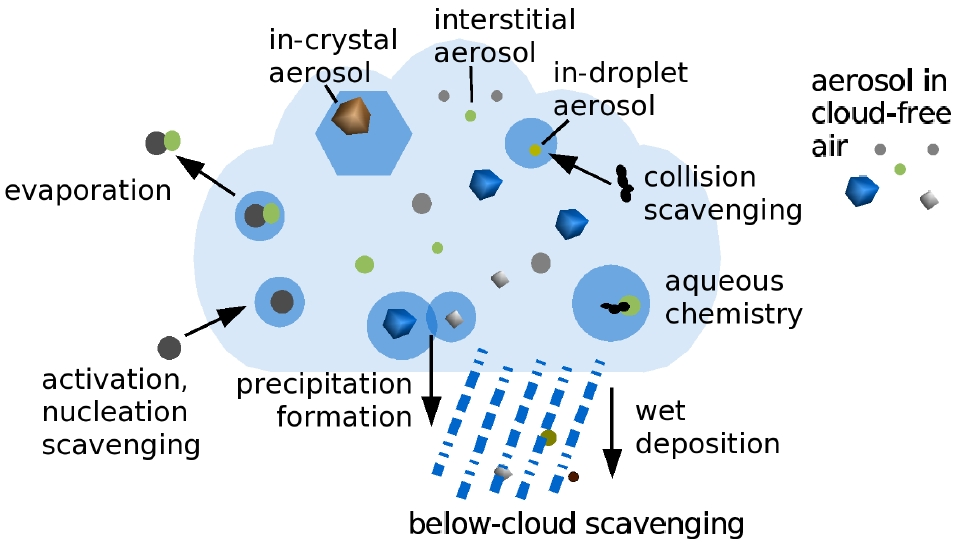
Figure 1: Aerosol processing in clouds - Physical and chemical processing inside cloud droplets contribute considerably to modifications of aerosol particles during their residence time in the atmosphere.2
Cloud seeding: Challenges and opportunities
In 1946, General Electric (GE) researcher Vincent Schaefer, while working on preventing aircraft wings from icing, accidentally discovered how to seed supercooled clouds with dry ice. Soon after, Bernard Vonnegut (brother of novelist Kurt Vonnegut) discovered that silver iodide worked even better as an ice-nucleating agent owing to closely matching crystalline structures.
On November 13, 1946, Vincent Schaefer and pilot Curtis Talbot flew a rented Fairchild airplane from Schenectady, New York, to conduct the world's first cloud-seeding experiment. They located a suitable cloud at 14,000 feet near Pittsfield, setting the stage for their historic test. The following extract from Schaefer 's laboratory notebook (Figure 2) describes what happened.[4]

Figure 2: Extract from Schaefer 's laboratory notebook as reported in History of Project Cirrus.4
Not only did this test demonstrate the laboratory findings, it became the first human-inspired weather modification event. Thus, the field of artificial cloud seeding (ACS) (Figure 3) was born. However, since then this field has had its share of controversy as illustrated by the following three events. [5]
In 1947, the US military and GE dropped nearly 180 pounds of crushed dry ice directly into the storm clouds of Category II Hurricane off the Florida coast to see if cloud seeding could disrupt destructive storms as a part of Project Cirrus. The storm cloud was predicted to travel out of harms way into the Atlantic Ocean, but instead took an unexpected turn shortly after seeding and slammed into Savannah, Georgia causing over $2 million in damage and claiming several lives. This brought the project to a halt.
During the Vietnam War (1967–1972), the U.S. military conducted Operation Popeye, when military aircraft seeded clouds with silver iodide flares to intentionally prolong the monsoon season over the Ho Chi Minh Trail. The goal was to generate heavy rainfall, trigger landslides, and wash out river crossings to disrupt North Vietnamese supply lines and troop movements. By extending the rainy season by roughly 30 days, the operation successfully turned key routes into mud. Its exposure in 1971 sparked widespread public outcry, ultimately leading to an international treaty banning environmental warfare.
On August 15, 1952, a catastrophic flash flood in Lynmouth, England, killed 35 people. While officially labeled a natural disaster, declassified documents from a 2001 BBC investigation revealed that RAF pilots and scientists conducted cloud-seeding tests nearby that very week under Operation Cumulus (nicknamed "Operation Witch Doctor"). Logbooks and eyewitness accounts from participants — such as pilot Alan Yates, who witnessed an intentional downpour —suggest the military was exploring rainmaking to bog down enemy forces or disperse atomic fallout. Though the Ministry of Defence denied responsibility and project results remained inconclusive, the tragic event forced an indefinite suspension of British weather modification trials.
From the above examples, it might appear that ACS is undesirable and dangerous. And just like any powerful technology, it can be (if misused). However, it has had tremendous benefits around the world.
A comprehensive decade-long, $14 million randomized cloud-seeding evaluation led by the National Center for Atmospheric Research (NCAR) confirmed that seeding suitable winter orographic storms produces a statistically significant 5% to 15% increase in precipitation, which translates directly into measurable streamflow increases (approx. 3.7%) feeding regional watersheds.[6]
To prevent destructive hailstorms that cause millions of dollars in damages, insurance and agricultural groups have funded the Alberta Hail Suppression Project since 1996. Pilots fly into severe summer thunderstorms to seed clouds with silver iodide, introducing millions of artificial ice nuclei. This causes atmospheric moisture to freeze across numerous small seeds rather than coalescing into large, damaging hailstones. Consequently, the storm releases a flurry of harmless slush or tiny hail instead of large stones that destroy property and crops. Overall, this cloud-seeding initiative successfully reduces regional hail damage by an estimated 20% to 50% each year. [7]
Idaho Power uses cloud seeding in the Snake River basin as a highly cost-effective strategy to enhance regional water security and boost hydroelectric generation. Investing roughly $3 million to $4 million each winter yields about 1 million additional acre-feet of water per season—roughly 325 billion gallons. At a cost of just $3 to $5 per acre-foot, cloud seeding far outperforms buying water on the open market or constructing new reservoirs, both of which cost tens to hundreds of dollars per acre-foot.[8]

Figure 3: Cloud seeding can be done by ground generators or planes.
Conclusion
In spite of these success stories, there are many challenges to ACS. For starters, silver iodide, the most widely used cloud-seeding agent is toxic to microorganisms and aquatic life and it is unknown how long-term usage can affect environmental health. Secondly, since atmospheric water is finite resource, causing clouds to precipitate in one region may deprive another region of water, which can foment regional and political tensions, and can, in some cases, lead to erratic precipitation (eg. flash floods). Finally, ACS can be expensive and without predictable and measurable effects, the costs may be hard to justify.
So, how can we balance the benefits of cloud seeding with its risks? A blanket ban on cloud seeding fails to ackowledge its necessity in arid regions, and a careless application could risk flash floods and property losses in inhabited zones. Careful and widely-publicized application of this technology could probably dispel conspiracy theories and increase public support for cloud seeding. What do you think?
-
Shelley, P. B. (2026). The cloud. Poetry Foundation. https://www.poetryfoundation.org/poems/45117/the-cloud-56d2247bf4112 ↩︎
-
Hoose, C., Lohmann, U., Bennartz, R., Croft, B., and Lesins, G.: Global simulations of aerosol processing in clouds, Atmos. Chem. Phys., 8, 6939–6963, https://doi.org/10.5194/acp-8-6939-2008, 2008. ↩︎
-
Physics Online. (2020, October 7). Stokes' Law for Laminar Flow - A Level Physics [Video]. YouTube. https://youtu.be/eD9H-2CQ2i0 ↩︎
-
Havens, B. S. (1952). History of Project Cirrus (Report No. RL-756). General Electric Company, Research Laboratory ↩︎
-
Harper, K. C. (2017). Make It Rain. University of Chicago Press. https://doi.org/10.7208/chicago/9780226437378.001.0001 ↩︎
-
Rasmussen, R., Tessendorf, S., Xue, L., Ikeda, K., & Lawrence, B. (2014). Wyoming Weather Modification Pilot Project (WWMPP) Final Report. National Center for Atmospheric Research / Wyoming Water Development Commission. ↩︎
-
Gilbert, D. B., Boe, B. A., & Krauss, T. W. (2016). Twenty seasons of airborne hail suppression in Alberta, Canada. The Journal of Weather Modification, 48(1), 68–92. https://doi.org/10.54782/jwm.v48i1.551 ↩︎
-
Witt, A. W. (2017). Seeding clouds of uncertainty. Jurimetrics, 57(1), 105–134. ↩︎